Last Updated: October 26, 2026
Quick Summary
A corporate shuttle is worth it for small teams when you match the vehicle to your headcount and book one pickup point with one arrival time. For teams under about 15 people on point-to-point routes, a van beats a full coach. Ask about minimum-hour rules and wait-time charges before signing.
- Skylink Limousine runs vehicles from 2 to 55 passengers with 24/7 support.
- Leo Charter Services publishes a starting rate of CAD $175 per hour with a two-hour minimum.
- Match the vehicle to headcount, then add one row of buffer.
- Confirm your peak headcount and every pickup address before requesting any quote.
- The two most common hidden costs are wait-time charges and minimum-hour rules.
Table of Contents
- Why Small Teams Struggle With Group Transport
- How We Evaluated Corporate Shuttle Providers
- Corporate Shuttle Options for Small Teams Compared
- When a Corporate Van Service Beats a Full Coach
- What an Employee Shuttle Service Should Include
- Your Corporate Shuttle Booking Checklist
- Requesting a Quote From Skylink Limousine
- Frequently Asked Questions
Why Small Teams Struggle With Group Transport
A corporate shuttle is a shared, scheduled vehicle service that moves a defined group of employees or guests between fixed points, and for small teams it solves a problem that cars and taxis handle badly. In the Greater Toronto Area, where a private car remains the default mode for most residents according to Toronto transportation system overview, that fragmentation adds up fast.
At Skylink Limousine, we see this pattern constantly: a team books individual rides, the first two arrive on time, the third gets stuck in traffic, and the client meeting starts without everyone in the room. The fix is not a bigger vehicle. It is a single booking with one pickup point and one arrival time.
Below, we compare the real options for moving small teams and show exactly what to ask before you sign a quote.
How We Evaluated Corporate Shuttle Providers
We scored each provider on four criteria: vehicle range, routing flexibility, pricing transparency, and support availability. Vehicle range matters most for small teams, because a provider that only runs 55-passenger coaches will either upsell you or turn you away. Routing flexibility covers whether pickup points can be customized or whether you must adapt to a fixed route.
Pricing transparency is where most providers fall short. Only one company in our comparison publishes a starting rate at all; the rest require a quote. That is not automatically a red flag, since shuttle pricing depends on distance, hours, and vehicle class, but it does mean you have to ask better questions up front.
Support availability separates a professional operation from a dispatch desk that closes at five. A team traveling at 6 AM for an airport run cannot afford a support line that opens at nine.
| Provider | Vehicle Range | Routing | Pricing | Support |
|---|---|---|---|---|
| Skylink Limousine | 2 to 55 passengers | Custom pickup points | Quote-based | 24/7 |
| GoGo Charters | Not listed | Custom, includes transit stops | Quote-based | Not listed |
| Signature Charters | Vans and Sprinters | Shorter routes | Quote-based | Not listed |
| Bus.com | Charter buses | Event-focused | Free quote request | Not listed |
| Leo Charter Services | 15-24 passenger bus | Corporate routes | From CAD $175/hour | Not listed |
Corporate Shuttle Options for Small Teams Compared
Five providers come up repeatedly when teams search for corporate transportation options for small teams in the Toronto area. They are not interchangeable. Each fits a different team size and trip pattern, and picking the wrong one usually shows up as an oversized vehicle, a route that does not match your office location, or a minimum-hour charge that swallows a short trip.
Skylink Limousine: Fleet Sizes From 2 to 55 Passengers
Skylink Limousine runs vehicles from 2 to 55 passengers, which means a five-person leadership team and a fifty-person client event can both be handled without splitting the booking across providers.
The fleet includes amenities such as Wi-Fi, privacy dividers, and entertainment systems, which turn a 40-minute run to the airport into usable working time.
Best for: teams that need one provider across a range of group sizes, from a two-person airport transfer to a full coach.
Skip if: you need a fixed public-transit-linked shuttle route rather than point-to-point charter service.
GoGo Charters: Customizable Pickup and Drop-Off Points
Routing flexibility is the headline here. GoGo Charters builds corporate shuttle routes with pickup and drop-off locations that can be customized, including public transit stops.
The tradeoff is visibility. The published information does not list rates or vehicle capacities, so you will need a quote conversation before you can judge fit.
Best for: teams whose staff are spread across multiple locations and transit hubs.
Skip if: you need confirmed vehicle sizes before you can approve a booking.
Signature Charters: Executive Vans for Shorter Routes
Signature Charters explicitly targets small workgroups and management teams with executive passenger vans and Sprinters, positioned for shorter shuttle routes.
If your shuttle is a 15-minute run between a parking lot and an office, or a short hop between two buildings, this is the right shape of service. Longer multi-stop days will likely push you toward a different vehicle class.
Best for: management teams and small workgroups on short, repeated routes.
Skip if: your route runs long distances or needs multiple stops across a full day.
Bus.com and Leo Charter Services: Charter and Mid-Size Bus Options
These two sit in a different weight class. Bus.com handles charter bus rentals for corporate events in the Toronto area and offers a free quote request, which suits teams organizing a single event rather than a recurring commute. Leo Charter Services lists a small-to-medium passenger bus for 15 to 24 passengers, publishes a starting rate of CAD $175 per hour with a two-hour minimum, and mentions both economy and executive options.
That published rate is the most transparent pricing in this comparison, and it is genuinely useful for budgeting. Just read the minimum: a two-hour floor means a 20-minute transfer is priced as a two-hour booking.
Best for: teams of 15 to 24 passengers, or one-off corporate event transport.
Skip if: your group is under 15 people or your trip is shorter than two hours.
When a Corporate Van Service Beats a Full Coach
A corporate van service wins whenever your group is under about 15 people and your route is point-to-point. Coaches make sense for conferences and large events.
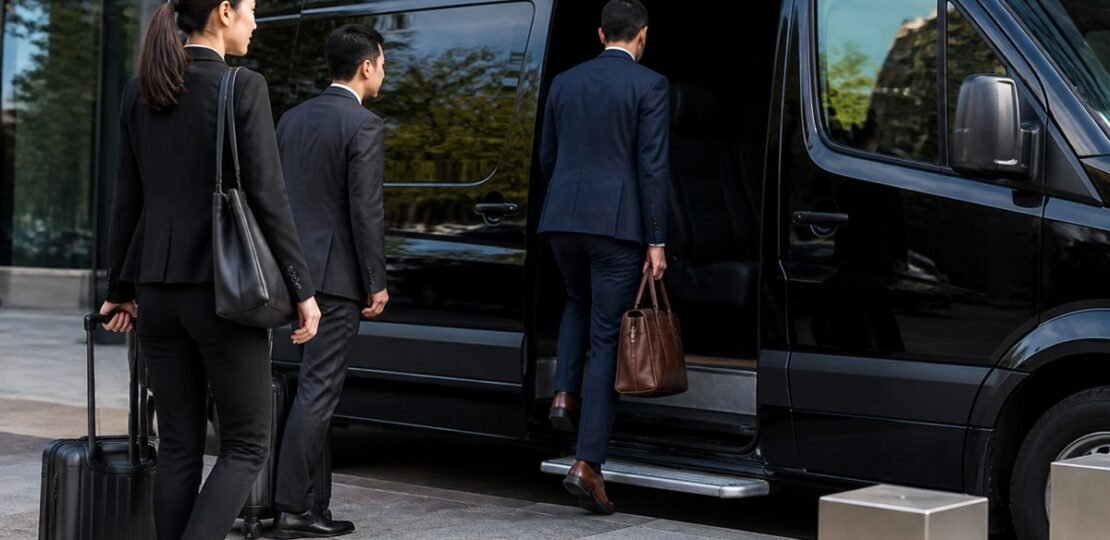
The practical rule is to match the vehicle to the headcount, then add one row of buffer. A six-person team fits a seven-passenger van comfortably. A twelve-person team needs a Sprinter-class vehicle, not two sedans and a coordination headache.
If you are weighing a van against something larger, it helps to see the actual coach bus option and the Sprinter van side by side before you decide. The difference in boarding time alone often settles the question.
What an Employee Shuttle Service Should Include
A properly built employee shuttle service covers four things: a fixed schedule your team can plan around, a documented pickup point, a named vehicle class, and a support line that answers outside business hours. Miss any one of those and the shuttle becomes another thing staff have to think about.

Here is what we would insist on in any employee shuttle contract:
- A locked schedule with departure times published at least a week ahead
- One designated pickup point per route, described precisely enough that a new hire finds it on day one
- A named vehicle class, so you know whether to expect a van or a coach
- Driver identification, meaning the driver’s name and mobile number reach the rider before pickup
- A late-arrival policy in writing, covering both rider lateness and vehicle lateness
- A single point of contact for changes, not a general dispatch queue
Your Corporate Shuttle Booking Checklist
Work through this before you request any quote. It takes ten minutes and prevents most of the surprises that show up on the invoice.
- Confirm your peak headcount, not your average
- List every pickup point with a full street address
- State your earliest departure and latest return time
- Ask whether the quote is locked or subject to traffic and wait-time charges
- Ask what the wait-time rate is and when it starts
- Confirm whether tolls and surcharges are included
- Ask for the specific vehicle class in writing
- Confirm the cancellation window and any fee
- Ask whether recurring bookings qualify for a corporate account rate
- Get the support number and confirm its hours
Watch out: the two most common hidden costs are wait-time charges that start earlier than you expect and minimum-hour rules that price a short trip as a long one. Both are avoidable if you ask before signing.
Requesting a Quote From Skylink Limousine
The fastest way to settle whether a shuttle fits your team is to put your actual numbers in front of a provider and get a written quote. Bring your headcount, your pickup addresses, and your schedule. Ask specifically what is included and what triggers an extra charge.
If you are ready to move, you can request a corporate shuttle quote and get your route and vehicle class confirmed in writing. For teams that want to see the full range first, our charter bus and corporate shuttle service page lays out the fleet from two to 55 passengers. And if you are still working out why group transport is so difficult in this city, the background on the local transportation system explains the car-first reality your shuttle has to work around.
Frequently Asked Questions
Is a shuttle or a private van better for a small business group?
It depends on headcount and route length. For teams of roughly 6 to 14 people on shorter runs, an executive van or Sprinter keeps costs down and is easier to park at client sites. Once you pass about 15 passengers, a small bus becomes the practical choice. A corporate shuttle works best when your group shares one route and one schedule; a private van suits teams that need to split off or change plans mid-day. Match the vehicle to the largest confirmed headcount, not the expected one.
How do I book a corporate shuttle for a small team?
Start by confirming four details: passenger count, pickup and drop-off addresses, date and time window, and whether you need a one-way or return trip. Send those to two or three providers and ask for a written quote that lists what is included. Ask specifically about waiting time, tolls, and cancellation terms before you sign. Reputable operators will confirm the vehicle type and the chauffeur’s contact details a day ahead. Book at least one to two weeks out for standard trips, and earlier during conference season.
Can a corporate shuttle accommodate multiple pickup locations?
Yes, and some providers build routes around it. Customizable pickup and drop-off points, including transit stops, are a standard feature with several Toronto operators. Each extra stop adds drive time and can trigger additional hourly charges, so group your pickups into one corridor where possible. Give the provider the full address list when you request the quote rather than adding stops later, since changes close to the date often carry a fee or may not be accommodated at all.
How far in advance should I book team transportation?
Two weeks is a comfortable lead time for a standard corporate shuttle, and it gives you room to compare quotes. Book three to four weeks ahead for large events, airport runs during peak travel periods, or anything requiring a specific vehicle size. Recurring employee shuttle service contracts need more notice, since the provider has to reserve a vehicle and driver for your schedule on an ongoing basis. Last-minute requests are sometimes possible but limit your choice of vehicle and provider.
What details should I provide when requesting a shuttle quote?
Give the provider passenger count, full pickup and drop-off addresses, date, start time, and expected duration. State whether you need a return trip and whether the schedule is fixed or flexible. Mention luggage or equipment if the group is heading to the airport or a trade show. Ask what the quote covers: chauffeur time, fuel, tolls, taxes, and waiting. A corporate shuttle booking checklist with these items in writing means every quote you receive is comparable, which makes the final decision much easier.
Coordinating a small team should not cost you a morning of dispatch calls. Skylink Limousine handles the routing, the vehicle sizing, and the schedule with professional chauffeurs in formal attire, 24/7 support, and a fleet that runs from two passengers to 55. Get started with Skylink Limousine and put your team on one vehicle, one pickup time, and one invoice.

RELATED POSTS
View all