Table of Contents
- Why Executive Transportation Matters for Business Travel
- Executive Car Service vs. Standard Rideshare: What Sets Them Apart
- Limo Versus Sedan for Business Travel: Choosing the Right Vehicle
- Corporate Group Transportation: Fleet Options and Capacity
- Business Travel Transportation Options: What to Compare
- Key Service Standards for Reliable Executive Transport
- Booking, Pricing, and Corporate Accounts
- Frequently Asked Questions
Last Updated: October 22, 2026
Why Executive Transportation Matters for Business Travel
Executive transportation goes beyond getting from point A to point B. It’s about arriving prepared, on time, and ready to perform, the quality of your journey directly affects how you present yourself at a client meeting, airport, or corporate event.
Business travelers face constant pressure: tight schedules, unpredictable traffic, and the expectation of professionalism at every touchpoint. A reliable executive transportation service removes variables, no navigating traffic, searching for parking, or worrying about vehicle maintenance. That mental space matters more than most people realize.
At Skylink Limousine, we’ve worked with business professionals across the Greater Toronto Area who understand this distinction. The difference between a standard rideshare and a dedicated executive car service isn’t just comfort, it’s reliability, consistency, and the assurance that someone else is managing logistics.
Executive Car Service vs. Standard Rideshare: What Sets Them Apart
The core difference comes down to accountability and consistency. Standard rideshare platforms match you with available drivers in real time, but you have no guarantee about the driver’s experience, vehicle condition, or arrival precision. Each trip is essentially a new relationship.
An executive transportation service operates differently. Your driver is vetted and professionally trained, the vehicle is maintained to specific standards, and you book in advance with a committed arrival time. When your flight departs at 6 AM, the car arrives at 5:15 AM, not 5:14 or 5:16.
For business travelers, this consistency is non-negotiable. A missed pickup can cost you a deal, damage your reputation, or derail your schedule. Rideshare works for leisure travel; for executive car service needs, the stakes are different.
Skylink Limousine maintains this standard through professional chauffeurs in formal attire, 24/7 support, and a fleet designed for business travel. When you book with us, you’re confirming a commitment, not hoping a driver shows up.
Limo Versus Sedan for Business Travel: Choosing the Right Vehicle
The vehicle decision should be driven by the trip’s purpose, passenger count, luggage volume, and how you want to be perceived on arrival.
Executive sedans are the default for one to three passengers: discreet, easy to park, and configured for work with quiet cabins, charging points, and a rear seat that lets you take a call or review a deck.
SUVs and crossovers suit two to four passengers with heavier luggage, winter gear, or golf clubs. They sit higher for easier entry, handle snow-belt roads with more confidence, and give a small team room to travel together.
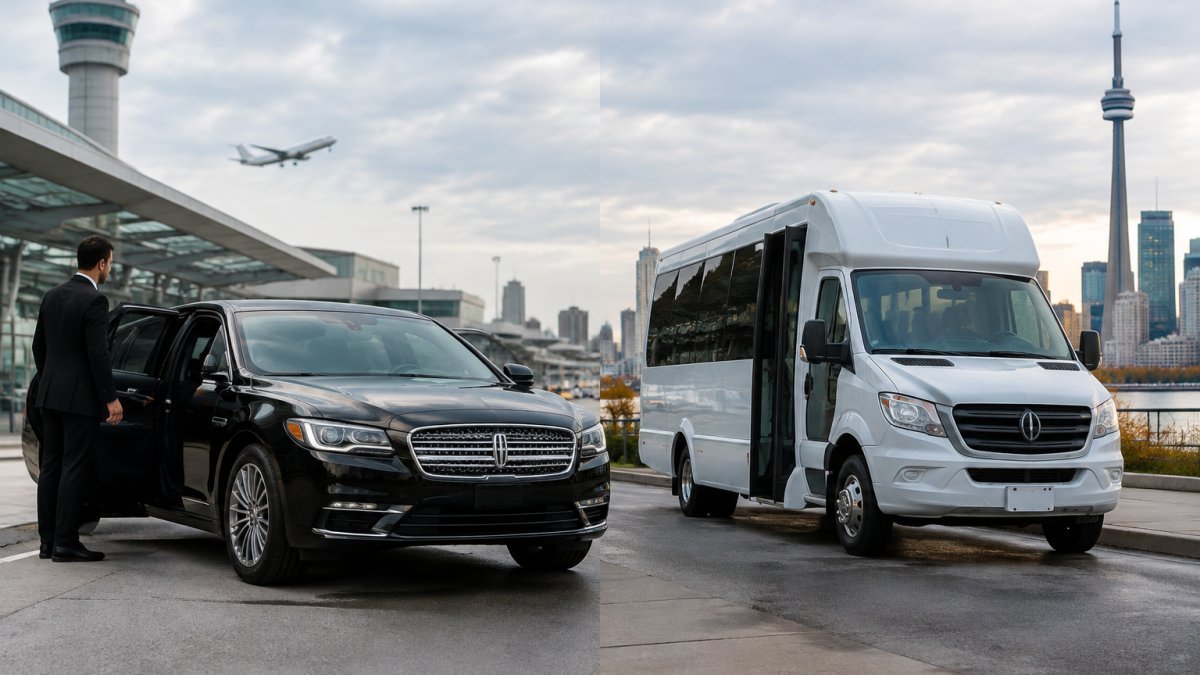
Executive vans and sprinters cover five to fourteen passengers, the practical choice for a leadership team moving between a hotel, office, and dinner, or a site visit where the group must arrive together.
Stretch limousines and party buses are event vehicles for weddings, milestone celebrations, and occasions where the journey is part of the experience.
Coaches handle larger groups, typically up to the mid-fifties depending on configuration. They are appropriate for conferences, corporate shuttles, and multi-stop itineraries where a single coordinated movement beats a convoy of cars.
A practical way to decide: count passengers, count large bags, and ask whether the vehicle needs to support work or host an occasion.

When you request a quote, ask for the vehicle class by name and the luggage capacity in pieces, not just passenger count. Two providers quoting the same trip can dispatch very different vehicles.
Corporate Group Transportation: Fleet Options and Capacity
When you’re transporting a team or client group, the logistics multiply. Coordinating multiple vehicles, ensuring drivers communicate, managing arrival timing, these details compound quickly.
A dedicated transportation provider handles group logistics as a single operation. Rather than booking three separate cars and hoping they coordinate, you book one service that manages the entire group’s movement: drivers communicate, timing is synchronized, and if one vehicle hits traffic, the service adjusts the others.
Fleet capacity matters here. Small providers may struggle to accommodate groups of 8, 12, or 20 on short notice; larger operations maintain diverse inventory for exactly this scenario.
Skylink Limousine’s fleet ranges from sedans for individual travelers to coaches accommodating up to 55 passengers. For a corporate conference requiring ground transportation for 40 attendees, we manage that as a coordinated operation, not as a scramble to book individual cars. Your team arrives together, on schedule, without the coordination burden falling on you.
This capacity also provides flexibility. A group that starts at 12 might grow to 15; a provider with diverse inventory can adjust vehicle allocation without canceling or restructuring bookings.
Business Travel Transportation Options: What to Compare
When evaluating executive transportation providers, focus on factors that directly impact your experience and reliability.
Consistency and reliability should top your list. How does the provider handle traffic delays? Are arrival times guaranteed or estimated? What happens if your flight is delayed? A provider that commits to specific timing and backs it with accountability is fundamentally different from one offering “best effort” service.
Fleet quality and diversity matters for flexibility. Can they accommodate your group size? Are vehicles maintained to professional standards? Do they offer options, sedan for routine travel, larger vehicles for groups? Limited inventory creates constraints.
Driver professionalism directly affects your experience. Are drivers trained in business etiquette, do they understand confidentiality, and are they familiar with business-travel routes and timing? A driver who knows the fastest route to the airport during rush hour can save you from missing your flight.
Amenities for productivity support the actual work you’re doing. Wi-Fi, phone charging, a quiet environment, climate control, these aren’t luxuries for business travel. They’re tools that let you stay productive during transit.
Payment flexibility and corporate account options matter for recurring travel. Do they offer online booking, a corporate account with billing that matches your accounting cycle, and multiple payment methods?
Responsiveness and support become critical when something goes wrong. If your flight lands early or your meeting ends ahead of schedule, can you reach someone immediately to adjust pickup timing? Is support available 24/7?
These factors separate a reliable business travel transportation partner from a basic ride service.
Key Service Standards for Reliable Executive Transport
Professional executive transportation providers maintain specific standards that distinguish them from casual services. These standards exist because business travel has zero tolerance for failure.
Punctuality is the first standard. For airport pickups, “on time” means arriving 15 minutes before your requested departure, not at it. Traffic is factored in, and the driver knows multiple routes and chooses based on current conditions.
Vehicle standards follow. The car is clean, mechanically sound, and maintained to professional appearance, leather intact, climate control working, interior organized and uncluttered.
Driver professionalism includes appearance, demeanor, and competence. Formal attire is standard; the driver is courteous, discrete, and focused on your needs, avoids excessive conversation if you’re working, and understands that confidentiality applies to conversations they overhear.
Communication standards matter. You should be able to reach the service with questions or changes: if your flight is delayed, timing adjusts; if you need to add a stop, they accommodate it. The relationship is responsive, not rigid.
Safety standards are non-negotiable. The vehicle is regularly inspected. The driver has a clean record. Insurance is current and adequate. These standards exist behind the scenes, but they’re fundamental to the service.
Skylink Limousine operates to these standards across every booking: professionally trained chauffeurs, a fleet maintained to specific specifications, and 24/7 support whenever something changes. These aren’t optional features, they’re the foundation of reliable executive transportation.
Booking, Pricing, and Corporate Accounts
Pricing is where most executive-transport comparisons break down, because providers quote in different units and bury different fees. To compare a Moe Limo alternative, ask for the same four numbers on every quote: the base rate, the billing unit, the wait-time policy, and the additional fees that can appear on the final invoice.
How executive transfers are typically billed
- Hourly service is billed per vehicle per hour, usually with a minimum engagement (commonly two to three hours) and billed in increments after that. Hourly suits multi-stop days, roadshows, and events where the vehicle waits for you.
- Point-to-point and airport transfers are billed as a flat rate between two locations, which makes budgeting easier but can vary by time of day and vehicle class.
- Group and coach service is usually quoted per vehicle rather than per passenger, so the per-person cost falls as the group grows.
Fees to ask about before you book
- Wait time. Airport pickups usually include a grace period after landing; beyond that, wait time is billed in increments. Ask what the grace period is and how it is measured, from scheduled arrival or from actual landing.
- Flight tracking and meet-and-greet. Confirm whether the provider monitors the flight and adjusts pickup automatically, and whether an in-terminal meet is included or an add-on.
- Stop charges. Extra stops on a point-to-point trip may be billed as additional time or a flat add-on.
- After-hours and peak surcharges. Early-morning departures, late-night pickups, and high-demand dates can carry surcharges. Ask for the window.
- Cancellation and change fees. Confirm the cutoff for free changes and the fee schedule after it.
- Gratuity and taxes. Clarify whether gratuity is included in the quote or added on the invoice, and confirm that quoted rates include applicable taxes.
Rather than quoting generic rates here, request a written quote for your actual itinerary. A reliable provider will itemize the base rate, the billing unit, and the fees above so you can compare like for like.
Booking lead times
Same-day requests are sometimes possible but depend on fleet availability. For airport transfers and single sedans, a day or two of notice usually suffices; for vans, coaches, and multi-vehicle group movements, allow more lead time, especially on peak dates. If your itinerary is recurring, set it up once and let the provider hold the pattern.
Corporate accounts and booking workflows
For teams with recurring travel, a corporate account changes the operating model. A typical setup includes:
- A central booking contact or portal so assistants and travel managers can book on behalf of executives without sharing payment details each time.
- A profile per traveler capturing pickup preferences, frequent addresses, and vehicle class defaults.
- Consolidated invoicing on a billing cycle that matches your accounts-payable process, with trip-level receipts for expense reporting.
- Change and cancellation authority defined up front, so an assistant can adjust an itinerary without a back-and-forth.
- A named account contact for escalations and service recovery.
When you evaluate a provider, ask how itinerary changes are handled after hours, whether receipts are itemized per trip, and who your team calls when a flight lands early. Those answers reveal more than the vehicle list does.
Compare quotes on four numbers, base rate, billing unit, wait-time policy, and additional fees, and confirm the corporate-account workflow before you commit. Transparency on those points is the clearest signal of a provider built for executive travel.
Frequently Asked Questions
What should I look for in an executive transportation service?
Reliable executive transportation requires professional chauffeurs, on-time performance guarantees, a modern fleet, 24/7 support, and transparent pricing. Verify that drivers maintain formal standards, vehicles include business amenities like Wi-Fi and privacy features, and the service offers flexible corporate accounts. Check customer reviews for consistency and ask about their guarantee if something goes wrong.
Is a limousine or sedan better for executive business travel?
Sedans suit one or two executives traveling to meetings or airport transfers, offering discretion and ease of navigation. Limousines work better for larger groups, client entertainment, or events where you want to make an impression. Consider passenger count, the formality of the occasion, and luggage needs. Many services offer both, so you can choose based on each trip’s requirements.
Can executive transportation services handle group bookings for corporate events?
Yes, most professional services operate fleets ranging from sedans to large coaches, accommodating groups of 2 to 55 passengers. Confirm capacity in advance, discuss driver coordination for multiple vehicles, and ensure the service can guarantee on-time pickup and drop-off for all passengers. Corporate accounts often include volume discounts and simplified booking for recurring group travel.
What’s typically included in executive transportation pricing?
Pricing depends on vehicle type, distance, time of day, and group size. Most services include the chauffeur, fuel, and basic amenities. Confirm whether tolls, waiting time, and service fees are included or charged separately. Ask about corporate account discounts for recurring bookings and whether pricing is locked in at the time of quote to avoid surprises.
RELATED POSTS
View all